Global Competency Record Project
Transforming Health Workforce Mobility Through Trusted Digital Recognition
The Global Competency Record (GCR) Project is an international initiative exploring how education, qualifications, skills, and workplace competencies can be documented, verified, recognized, and shared across borders more effectively.
Led by Centennial College, TruMerit, and the GDN Network, the project aims to demonstrate a trusted, interoperable digital record of demonstrated competencies that follows individuals throughout their learning and professional journeys.

The Challenge
Across the world, professionals seeking recognition in a new country often encounter fragmented systems, repeated credential verification, inconsistent competency frameworks, and lengthy regulatory processes.
These barriers are particularly evident in healthcare, where many countries face workforce shortages while qualified professionals experience delays in entering practice.
The result is duplicated effort, lost talent, underemployment, and slower integration of skilled professionals into the workforce.
Featured Research
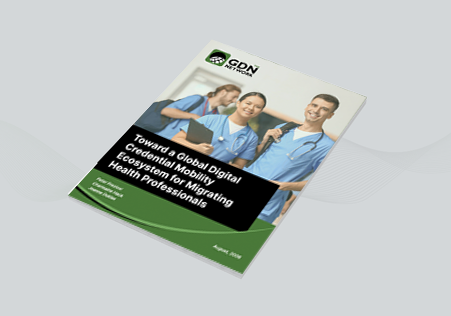
Toward a Global Digital Credential Mobility Ecosystem for Migrating Health Professionals (2026)
As healthcare systems worldwide face persistent workforce shortages, internationally educated health professionals often encounter lengthy, duplicative, and inconsistent credential recognition processes that can delay entry into practice. The paper proposes a new approach centered on a Global Competency Record (GCR). This portable digital record could securely bring together verified evidence of a professional’s education, training, work experience, certifications, and demonstrated competencies throughout their career.
The Vision
The Global Competency Record seeks to move the conversation from recognizing documents to recognizing demonstrated capabilities.
Rather than creating new standards or replacing existing regulatory frameworks, the initiative explores how existing standards, digital credential technologies, and trusted practices can work together to improve mobility and recognition across jurisdictions.
The proposed approach would:
Map demonstrated capabilities to professional standards while identifying areas requiring additional assessment or bridging.
Provide trusted evidence to employers and regulators while maintaining their authority to make final recognition and licensing decisions.

Initial Focus: Healthcare and the Care Economy
The first phase of the project focuses on healthcare and the care economy, where workforce mobility challenges have significant social and economic impacts.
Nursing
A regulated profession requiring licensing, competency assessment, and jurisdiction-specific standards.
Personal Support Work
A less formally regulated occupation where demonstrated skills, experience, and practical competencies are often key indicators of workforce readiness.
Together, these use cases provide an opportunity to test the model across different recognition environments before potential expansion into other professions.
Key Collaborators and Supporting Organizations
- Centennial College: Centennial College is Ontario’s first community college, established in 1966, primarily serving the eastern portion of the Greater Toronto Area through five campuses and seven satellite locations. It has a record of exemplary teaching, innovative programming and extensive partnership building. Centennial is recognized as one of the most culturally diverse post-secondary institutions in Canada. Almost 100 ethno cultural groups are represented and 80 languages are spoken on campus.
- TruMerit: TruMerit is a worldwide leader in healthcare workforce development with nearly 50 years of experience supporting the mobility of nurses and other healthcare workers. Formerly CGFNS International, TruMerit validates the education, training, and professional experience of internationally educated health professionals seeking authorization to practice in the United States and other countries. Through its expanded mission and the Global Health Workforce Development Institute, TruMerit advances research, standards, and certifications that strengthen the global health workforce and promote equitable, sustainable career mobility.
- The GDN Network: The GDN Network is an international, non-profit federated trust located in the Netherlands. It represents a voluntary network of like-minded organizations and individuals that seek to make digital student data portability happen. Its network of thought leaders from around the globe are collaborators who seek to support, advise, and offer innovative changes in the ways we share artifacts of academic learning. The GDN Network seeks common ground in best serving the academic and professional mobility needs of citizens worldwide by bringing together stakeholders in the digital student data ecosystem. It seeks to develop and support best practices and globally accepted standards for safe and citizen-oriented convenings and information exchanges.
- UNESCO Global Convention on Higher Education:An international framework promoting fair, transparent, and non-discriminatory recognition of qualifications and prior learning across borders.

Looking Ahead
Planned activities include:
Building strategic partnerships
Identifying funding opportunities
Developing a Global Competency Record prototype
Conducting interoperability and use-case testing
Exploring governance and implementation models
Evaluating privacy, security, and ethical considerations
Related Conversations and Resources
GDN Conversation Series: Exploring the Dimensions of Trust with Velocity Network Foundation – Session 4: Innovation in Action: Case Study in Healthcare Recognition
In this session, participants gained practical insights from a case study on driving digital innovation adoption within a healthcare recognition ecosystem. The webinar explored how digital tools and strategies can address specific industry challenges and create opportunities for broader application across sectors.
Topics covered included:
- An overview of healthcare recognition challenges and the solutions implemented.
- Identification of key stakeholders and their roles in the innovation process.
- Digital innovation tools, including their implementation and outcomes.
- Strategies for building an ecosystem that fosters trust and collaboration.
- Key lessons learned and considerations for applying these approaches in other industries.
- TruMerit "Ethical International Recruitement".
TruMerit promotes ethical international recruitment of health professionals through its stewardship of the Alliance for Ethical International Recruitment Practices and its Health Care Code, which advances fair, transparent recruitment and protects migrant health workers’ rights.
Interested in contributing to the Global Competency Record Project?
Not yet part of the GDN community? Join us