Advancing Global Workforce Skills Recognition
To co-create a strategic roadmap for GDN’s initiatives in workforce skills recognition, focusing on lifelong learning and mobility.
Context
As the global labor market rapidly evolves, there is an urgent need for systems that recognize prior learning, facilitate swift upskilling and reskilling, and ensure that achievements are portable across borders. GDN members have emphasized the necessity for transnational frameworks, digital solutions and credential recognition models that allow learners to securely and seamlessly share quality assured outcomes of their education and training.
The community of practice aims to identify emerging themes in digital innovations and interoperability with the expert input of the GDN community, as we work together to catalyse opportunities that ensure that learners have faster, fairer, and more inclusive access to both education and employment opportunities.
This primer aims to provide participants with a comprehensive understanding of the current landscape in workforce skills recognition and to facilitate informed discussions during the roundtable. Your insights and contributions will be invaluable in shaping the future direction of GDN’s initiatives in this critical area.
Key Discussion Questions
Strategic Focus Areas
- Where are the gaps and where should GDN focus its immediate and longer-term efforts to build a sustainable roadmap for workforce skills recognition?
- How can GDN ensure that its initiatives align with the diverse needs of its global community?
Transnational Frameworks
How can GDN foster transnational frameworks that strengthen skills recognition and assessment across borders?
What role can international collaborations play in harmonizing standards and practices?


Digital Innovations and Interoperability
- What role should digital innovations and interoperability play in ensuring learners can effectively share their skills and credentials across borders?
- How can GDN support the development of secure and seamless digital platforms for skills recognition?
Leveraging Partnerships
- How can GDN partnerships be leveraged to amplify impact and avoid duplication in this space?
- What strategies can GDN employ to foster effective collaborations with stakeholders such as educational institutions, employers, and governments?
Desired Outcomes
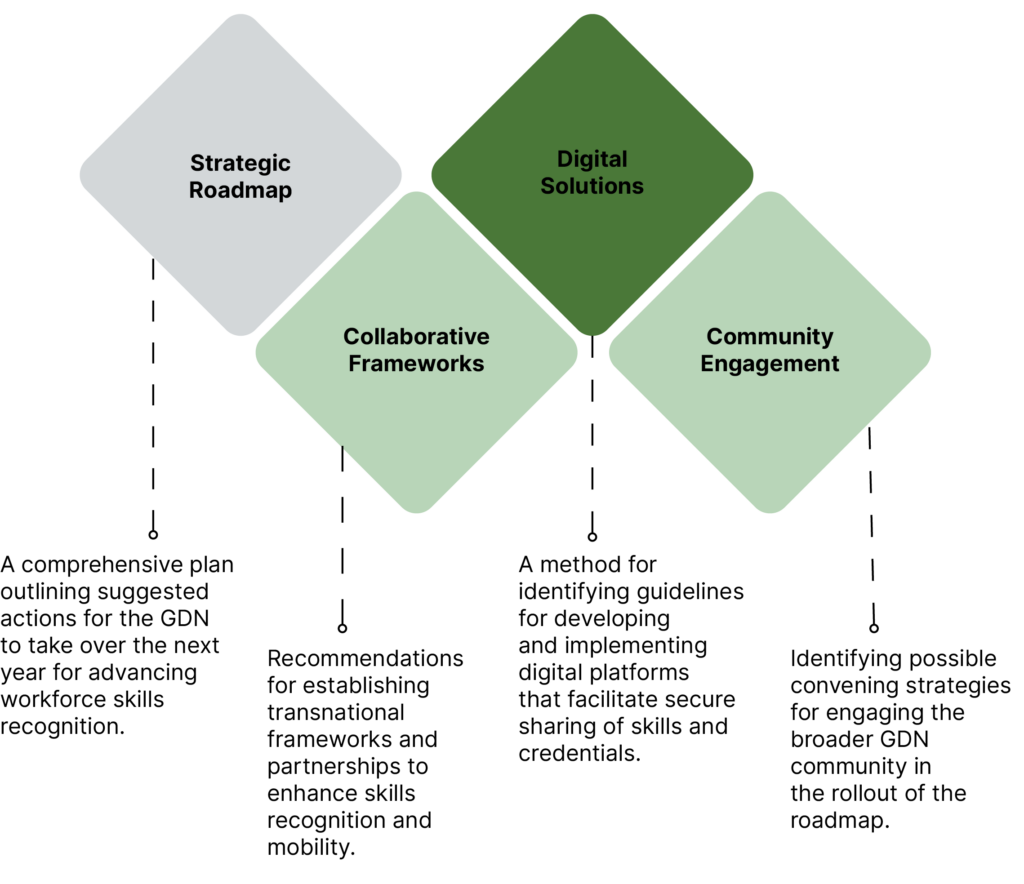
Strategic Roadmap
A comprehensive plan outlining suggested actions for the GDN to take over the next year for advancing workforce skills recognition.
Collaborative Frameworks
Recommendations for establishing transnational frameworks and partnerships to enhance skills recognition and mobility.
Digital Solutions
A method for identifying guidelines for developing and implementing digital platforms that facilitate secure sharing of skills and credentials.
Community Engagement
Identifying possible convening strategies for engaging the broader GDN community in the rollout of the roadmap.
A Sampling of Promising Initiatives
These initiatives demonstrate a global commitment to leveraging digital technologies and standardized frameworks to enhance workforce skills development, facilitate access to learning and employment, and promote economic mobility.
UNESCO’s Global Skills Academy (GSA) is an initiative under the Global Education Coalition, aiming to support ten million youth and adults globally in building essential skills for improved employability by 2029. The GSA offers free, high-quality online training courses, addressing pressing labor skills gaps and empowering individuals for a future-ready workforce. UNESCO
The European Commission’s Union of Skills initiative focuses on building skills for quality jobs, upskilling and reskilling an agile workforce, and facilitating the circulation of skills across EU member states. This comprehensive effort aims to improve skills development, workforce mobility, and job quality across the European Union. European Commission
WICHE has explored the relationship between Recognition of Prior Learning (RPL) and employers, highlighting how RPL can be leveraged to reskill existing employees in a rapidly changing labor market. The initiative emphasizes the importance of aligning RPL practices with employer needs to enhance workforce development. WICHE
The American Association of Collegiate Registrars and Admissions Officers (AACRAO) has been a leader in advancing Learner and Employment Records (LERs). LERs enable individuals to own, manage, and share their learning and employment data across educational institutions, employers, and other stakeholders. AACRAO’s LER Accelerator coalition aims to increase awareness and reduce obstacles to the adoption of digital credentials in post-secondary education. AACRAO
America Succeeds is a nonprofit organization dedicated to advancing the development and recognition of “Durable Skills”—a set of competencies that include critical thinking, communication, collaboration, creativity, leadership, growth mindset, and fortitude. These skills are increasingly demanded by employers across various industries and are essential for long-term career success and economic mobility. Through its research and advocacy, America Succeeds has identified that seven out of the ten most requested skills in job postings are Durable Skills, highlighting their importance in the modern workforce. America Succeeds
Evolving from the early work on the Industry Skills Accelerator, TAFE NSW, with matched funding from the Australian and New South Wales governments under the National Skills Agreement, has established Manufacturing Centres of Excellence to help address skills shortages in high-priority sectors. Through this initiative, they deliver a spectrum of microskills (very short, often 2-hour modules) and microcredentials (8-week courses) focused on topics such as generative design, digital manufacturing integration, robotics, hydrogen technologies, and sustainable manufacturing. These offerings are fully subsidised (fee-free) and open to a broad range of learners — from school students and apprentices to existing workers — with the goal of upskilling individuals in emerging technologies and enabling smoother transitions into advanced manufacturing roles. TAFE NSW
New Zealand has adopted the SFIA framework to define the digital skills, knowledge, and behaviors needed across the public sector workforce. This standardized framework supports consistent career pathways, skills assessment, and strategic workforce planning, facilitating the recognition and development of digital competencies. SFIA
The African Union’s Digital Transformation Strategy emphasizes the development of digital skills and human capacity as a foundational pillar. The strategy aims to enhance digital literacy and competencies across the continent, thereby improving access to digital jobs and fostering economic growth. African Union
Launched in September 2021 following endorsement by the Council for Human and Social Development (COHSOD), the CARICOM Digital Skills Task Force unites Member States, regional bodies and international partners to advance digital literacy and workforce readiness across the Caribbean. Since its inception, it has produced a regional workplan, held public consultations and begun drafting a Digital Skills Strategy aligned with the Caribbean Vocational Qualification framework. Its work underpins the CARICOM Digital Resilience Strategy, endorsed in July 2024, which established a Digital Skills Fund, a Digital Skills Training & Learning Network and the “Digi-Smart” initiative to train 10,000 youths in targeted digital skills. A proposed Digital Skills Commission, discussed at the February 2025 Heads of Government meeting, will further scale and institutionalize these efforts. As an illustration and effective September 2025, four member states (Barbados, Trinidad and Tobago, Jamaica and Grenada) are modernising TVET education through a pilot digitalization project.
The Inter-American Development Bank (IDB) has developed a Digital Credential Framework to guide the creation and issuance of digital credentials in Latin America and the Caribbean. This framework aims to enhance the recognition of knowledge acquisition and continuous learning, facilitating mobility and access to employment opportunities across the region. IDB
The Association of Southeast Asian Nations (ASEAN) has initiated efforts to establish a digital credential recognition system. This system aims to create a unified approach to recognizing and transferring digital credentials across member countries, enhancing workforce mobility and access to learning and employment opportunities. ASEAN
The C-BEN vision is to revolutionize education and workforce development to better meet the needs of both learners and employers, ultimately creating skills-based systems that recognize people for what they know and can do. C-BEN
This framework is designed for teachers, education leaders, education policymakers, and learning designers. It outlines competences and learning scenarios to inform learning materials, standards, school-wide initiatives, and responsible AI policies for primary and secondary education settings. The AILit Framework for primary and secondary education is a joint initiative of the European Commission (EC) and the Organization for Economic Cooperation and Development (OECD).
This publication aims to help educators integrating artificial intelligence learning objectives into official school curricula to prepare students to be responsible and creative citizens in the era of AI. UNESCO AI Competency Framework
A Sampling of Tools
Initial research indicates a growing number of actions within the corporate world to address skills preparedness. Here is a sampling which have not been formally assessed but are provided as an illustration of the ongoing innovations and activity in this space. Often, these types of tools profess to facilitate upskilling, cross-skilling, and seek to help learners identify their skills to connect with job opportunities.
LinkedIn Learning offers personalized career guidance powered by internal talent data and insights from LinkedIn’s vast professional network. It provides personalized career paths and AI upskilling through its online learning platform, helping learners acquire relevant skills and connect with job opportunities. (LinkedIn Learning)
CareerOneStop’s Skills Matcher is an interactive tool that allows users to rate themselves on 40 key workplace skills. Based on their ratings, the tool suggests career options that match their skills, helping learners identify potential job opportunities aligned with their abilities. (CareerOneStop)
SkillTrade is a platform that facilitates skill swapping, learning, and career growth. It connects individuals with matching skills, allowing them to collaborate virtually and learn from each other. Users can create profiles, connect with others, share skills, and respond to job ads from startups, fostering a community-driven approach to skill development. (arXiv)
Google offers free online training programs through its Google Career Certificates platform. These programs are designed to help learners acquire in-demand skills in fields like IT support, data analytics, project management, and UX design, providing a pathway to new career opportunities. (Grow with Google)
IBM SkillsBuild is a free education initiative aimed at bridging the digital skills gap and promoting diversity in the technology sector. It offers a variety of learning resources, including courses and certifications, to help learners develop skills in areas such as cybersecurity, AI, and cloud computing. (IBM SkillsBuild)
Degreed is an AI-driven learning experience platform that assists organizations in identifying skill gaps, providing personalized learning paths, and automating learning experiences for upskilling and reskilling. It enables personalized learning linked to career opportunities, helping learners acquire new skills and advance in their careers. (Degreed)
Salesforce’s Career Connect is an AI-powered internal talent marketplace that helps employees identify personalized career paths, relevant training, and job opportunities based on their skills and goals. Integrated with Slack as Career Agent, it offers real-time guidance and resource recommendations, facilitating internal mobility and career development. (Salesforce Career connect)
Upcoming Events
Helpful Resources
Research Brief: The Value of Verifiable Credentials to Individual Learners & Job Seekers
https://www.velocitynetwork.foundation/research-brief-the-value-of-verifiable-credentials-to-individual-learners-job-seekers
What is the Groningen Declaration Network (GDN)?
GDN is a voluntary, nonprofit network committed to enabling digital learner/student data portability. Its vision is that citizens globally should be able to consult and share their authentic educational data safely, securely, and with autonomy.